
Intercooler Sizing For Rotary Turbo Builds
A turbocharged rotary engine produces compact power but significant heat. The intercooler must reduce charge-air temperature without becoming a restriction between the compressor and throttle body. For an RX-7, selecting the largest available core is rarely the best answer.
Core volume, frontal area, thickness, internal fin design and end-tank shape all influence performance. A suitable intercooler keeps intake temperatures stable during repeated pulls while preserving throttle response and avoiding excessive pressure drop.
This matters on 13B-REW, street-ported 13B and larger 20B projects alike. A mild street car has different airflow and packaging needs from a drag, circuit or roll-racing build, even when both use a similar turbocharger.
Australian conditions add another variable. Summer traffic in Sydney, Brisbane and Perth can heat-soak a front mount before a highway run, while long distances between towns make dependable temperature control more valuable than a short dyno result.
Core Volume And Frontal Area
Intercooler core volume is calculated by multiplying the core length, height and thickness. It gives a useful indication of the amount of internal passage available for charge air, but it does not directly predict cooling performance. Two cores with identical dimensions can have very different pressure losses and heat-transfer results.
Frontal area usually deserves priority over extreme thickness. A broad core receives more direct airflow and can provide adequate cooling with less restriction. A very thick unit may offer greater volume yet sit in stagnant air behind the bumper, condenser or radiator. On an FD RX-7, bumper openings, crash structure and ducting often limit the practical dimensions.
For a responsive street rotary, a moderate-thickness bar-and-plate or tube-and-fin core with a large frontal face is often easier to cool than an oversized, deeply buried unit. Measure the available opening rather than relying on advertised external dimensions.
Matching The Core To Airflow
Required intercooler flow depends on engine power, boost pressure, compressor efficiency and engine speed. A rough estimate can begin with the turbocharger’s compressor map and expected mass airflow, then allow headroom for future changes. A core chosen for a low-boost 13B may become restrictive when the owner later adds a larger turbo, higher boost or a bridge-port.
The key measurements are pressure before and after the intercooler and air temperature at the same operating point. A pressure drop around 1 psi may be acceptable in a responsive street setup, while a larger loss can force the turbocharger to work harder. Logging manifold pressure, compressor outlet pressure and intake temperature gives a more useful picture than core dimensions alone.
Tube Design And Pressure Drop
Internal tube height, fin density and passage count affect how easily air moves through the core. Tight fins can increase heat-transfer area, yet they may collect dust and insects or restrict airflow. This is relevant in Australia, where rural roads, summer debris and long highway runs can expose the front of the car to harsh conditions.
End tanks deserve equal attention. Smooth transitions help distribute air across the core instead of loading only the first few passages. Poorly shaped tanks can create local turbulence and uneven cooling, even when the intercooler appears large. Short, properly supported piping also reduces volume between the throttle body and compressor, helping transient response.
Air-To-Air Or Water-To-Air
Air-to-air intercoolers are simple, light and well suited to many road-going RX-7s. They need a clear path to ambient air and benefit from sealed ducting between the bumper opening and core. A properly ducted unit is more effective than a larger core exposed to engine-bay air.
Water-to-air systems can provide compact plumbing and strong short-duration cooling, which may suit a tightly packaged FD or a competition car. Their heat exchanger, pump, reservoir and water temperature must be considered as a complete system. In slow Melbourne traffic or repeated summer sessions at Queensland Raceway, a small water circuit can eventually heat-soak unless its radiator capacity is sufficient.
Packaging An RX-7 Installation
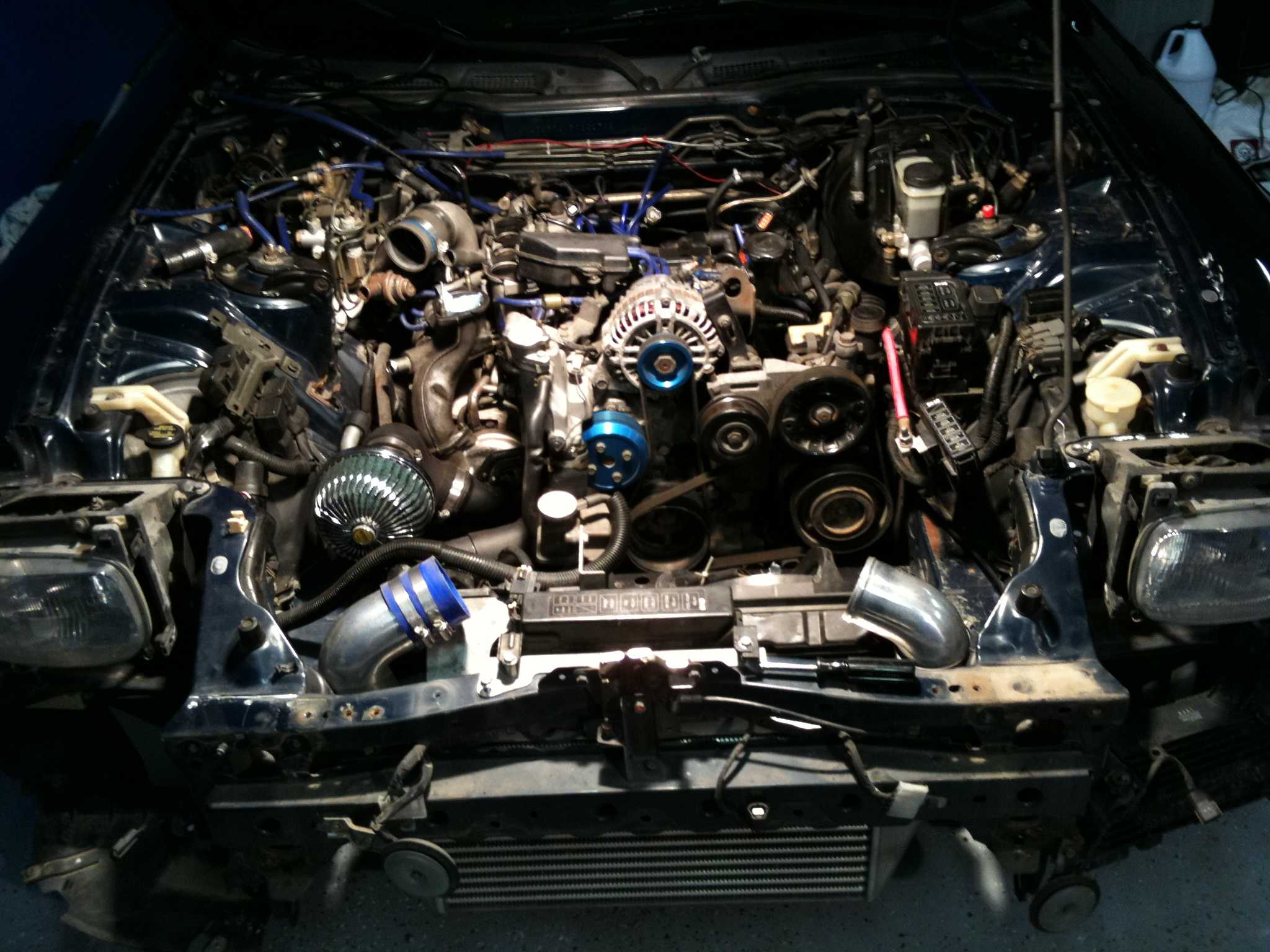
The intercooler should work with the radiator, oil cooler and condenser rather than blocking them. Rotary engines place high demands on cooling systems, and a front mount that leaves no clean path for radiator air can create coolant temperature problems. Check bonnet clearance, bumper reinforcement, number-plate position and crash protection before choosing the core.
Pipe diameter should match the turbocharger outlet, throttle body and expected airflow. Excessively large piping increases charge volume and can soften response, while undersized piping raises velocity and pressure drop. Keep bends smooth, use strong couplers and support the piping so vibration does not damage the turbo outlet or throttle body.
When verifying an imported or modified car, factory references can clarify original cooling layouts and equipment. The RX-7 VIN guide is useful when identifying the exact generation and specification before planning changes.
Temperature Control In Real Use
Dyno airflow can make an intercooler look better than it behaves on the road. Log intake-air temperature before the throttle, ambient temperature, boost pressure and vehicle speed during several pulls. A core that performs well once may show rising temperatures after repeated acceleration if its thermal mass or airflow path is inadequate.
Aim for stable post-intercooler temperatures rather than an impressive single minimum value. Consistent charge temperature supports safer ignition timing and fuel calibration. This is especially important for rotary engines, where detonation control, exhaust gas temperature and cooling-system condition must be considered together.
Owners driving across the Nullarbor or towing a track car need to assess sustained load, not just peak power. A sensible intercooler retains cooling capacity during long climbs, hot restarts and traffic rather than relying on brief bursts of airflow.
Tuning And Engine Protection
Changing intercooler size can alter pressure drop, boost response and the relationship between compressor pressure and manifold pressure. After installation, confirm boost control and retune where necessary. An electronic management system such as Apex’i PowerFC may require revised airflow, fuel and ignition settings when the complete intake arrangement changes.
A 13B-REW’s factory configuration should be treated as a baseline, not a universal template for every build. The 13B MSP comparison helps distinguish rotary architectures before applying assumptions about airflow, porting or thermal behaviour.
Use reliable factory data when checking sensor locations, original pipe routing and cooling components; the OEM information archive provides a useful reference point. Keep technical bookmarks separated from unrelated web resources, including a separate reference bookmark, so build research remains easy to audit.
Choosing A Practical Specification
Start with the target power level, turbocharger map, intended use and available frontal area. Select a core that can support the projected airflow with modest pressure drop, then confirm that ducting, piping and the radiator retain adequate airflow. A slightly smaller, well-sealed intercooler can outperform a huge unit installed without a clear air path.
For Australian street use, corrosion resistance, stone protection and service access matter as much as published efficiency figures. Check weld quality, fin condition, drain points and mounting strength before installation. Keep the design compatible with future fuel, turbo and engine-management changes without sacrificing drivability today.
Measure compressor outlet pressure and post-core pressure, record intake temperatures under repeatable conditions, and inspect the cooling stack after real road testing. Those results provide a defensible basis for final tuning and show whether the intercooler is genuinely helping the rotary engine.
Build a simple log sheet for boost, inlet temperature, outlet temperature, pressure drop and ambient conditions, then use the results to refine the core, ducting and tune. Careful measurement turns intercooler sizing from guesswork into a reliable part of the RX-7 build.